Beautiful Damage: The Artists Who Made VHS Decay Their Whole Medium
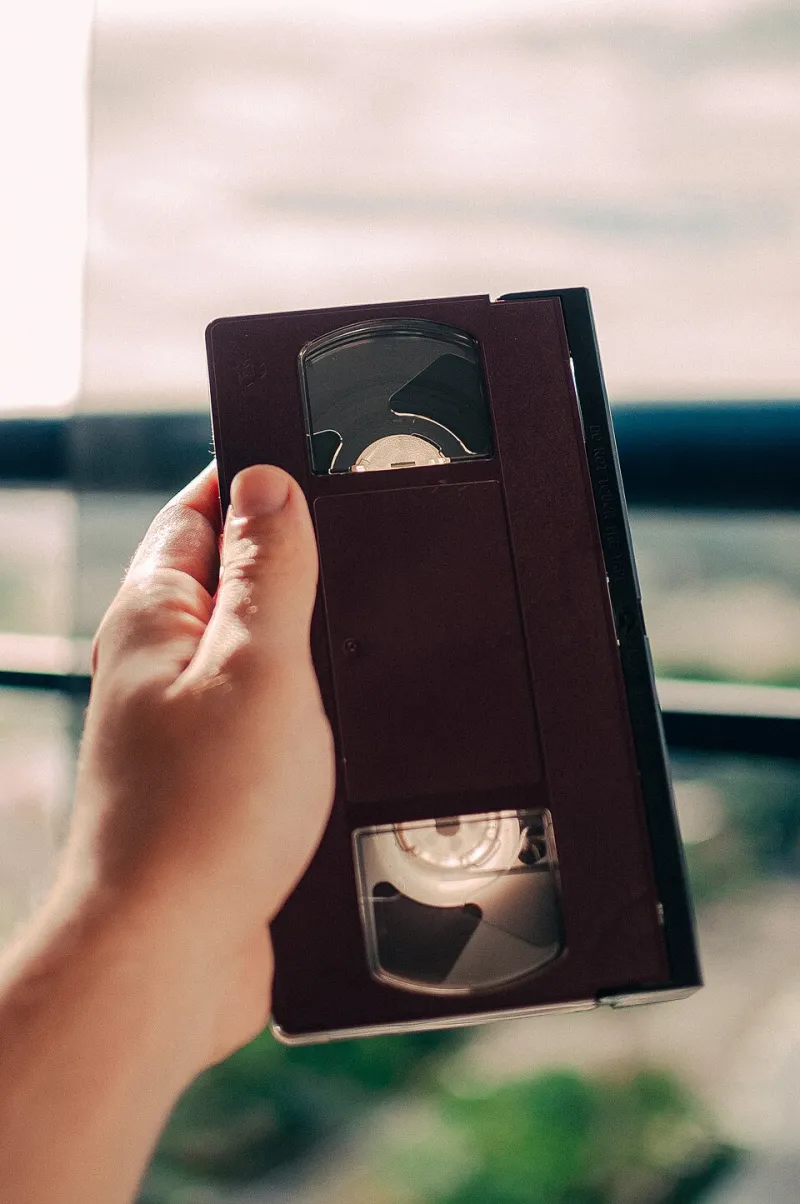
Photo: Gabriel Petry igpetry, CC0, via Wikimedia Commons
There's a moment in the lifecycle of a VHS tape — somewhere around the hundredth playback, or after a few years in a humid basement — where the image starts to do things it was never designed to do. Colors bleed horizontally across the frame. The tracking line crawls up from the bottom of the screen. Faces dissolve into phosphorescent smears. For most people, this is the moment you throw the tape away.
For a specific and deeply committed community of artists, this is where the interesting stuff begins.
Tape as Raw Material
The deliberate use of VHS degradation as a creative tool has roots that go back further than most people realize. Through the 1980s and into the '90s, a scattered network of video artists — many of them working in the tradition of Nam June Paik and the Fluxus movement, others coming from punk music scenes, others operating in genuine isolation — were experimenting with what happened when you broke the rules of the format on purpose.
They discovered that VHS tape responded to physical manipulation in ways that were unpredictable but learnable. Running a magnet along the length of a tape produced specific kinds of interference patterns. Partially demagnetizing a section created zones of visual noise that could be positioned within the frame. Exposing tape to heat, moisture, or direct light introduced decay artifacts that had their own visual logic. None of this was documented in any manual. It was empirical knowledge, developed through destruction.
The results looked like nothing else. Pre-digital, there was no software tool that could replicate what a physically damaged tape did to an image. The artifacts were analog — continuous, unpredictable, impossible to reproduce exactly. Every damaged tape was unique.
The Festival Circuit That Almost Wasn't
For most of the '90s, this work existed in genuine obscurity. It screened at alternative art spaces, circulated on dubbing networks, got reviewed occasionally in zines that most people reading this have never heard of. The mainstream art world wasn't interested. The film world wasn't interested. The music video industry, which occasionally flirted with lo-fi aesthetics, wanted the look of tape degradation without the actual unpredictability.
Then something shifted. By the mid-2000s, a small number of festivals dedicated specifically to video art and experimental media began programming this material more consistently. Not because the work had changed — much of what was being screened was a decade old — but because the cultural context had. Digital video had become dominant, which meant that analog artifacts were now visually distinct in a way they hadn't been when they were simply the default texture of cheap video.
What had looked like failure now looked like a choice. And once it looked like a choice, it started looking like art.
The Collectors and the Mystique
A secondary market for physically degraded tapes has developed alongside the festival circuit, and it operates according to logic that would confuse any traditional art collector. The most valued objects in this space are often the most damaged — tapes where the image has partially collapsed, where the audio has warped into something unrecognizable, where the original content has been so thoroughly corrupted by physical decay that what remains is essentially abstract.
This creates some genuinely strange provenance questions. If an artist deliberately damages a tape to produce a specific visual effect, and then that tape continues to degrade over subsequent years, is the resulting object the artist's work or something else? Some collectors argue that ongoing decay is part of the piece — that they're not acquiring a static object but a process, something that will look different in ten years than it does today.
Others seek out tapes that have reached a kind of terminal state — so damaged that no further significant change is possible — on the theory that these represent a completed work rather than a work in progress.
The artists themselves tend to be divided on these questions, which tracks with the broader tradition of conceptual art arguing with itself about what an object actually is.
Contemporary Practice and the Digital Fake
The current generation of artists working in this space has to contend with a problem their predecessors didn't: digital tools that can simulate VHS degradation with considerable accuracy. Any competent editor can add a tracking line or a color bleed in After Effects in about thirty seconds. The aesthetic has been thoroughly colonized by YouTube intros, lo-fi hip-hop channels, and horror game trailers.
For artists committed to working with actual tape, this has created a strange authentication problem. Work produced through genuine physical degradation — which requires time, physical media, and a tolerance for results you can't fully control — now has to compete for attention with work that achieves a superficially similar look through entirely algorithmic means.
Some practitioners lean into the distinction aggressively, emphasizing process documentation and the irreproducibility of physical tape as core parts of their practice. Others have moved toward working with degradation at scales or in formats that digital simulation can't convincingly replicate — large-format projection, multi-channel installation, live performance with decaying playback equipment.
A few have simply stopped explaining. The work looks the way it looks. Whether that means anything to you probably depends on whether you've ever held a tape that's falling apart in your hands and felt something you couldn't quite name.