Static and Soul: The Underground World of Shortwave Radio's Secret Communities
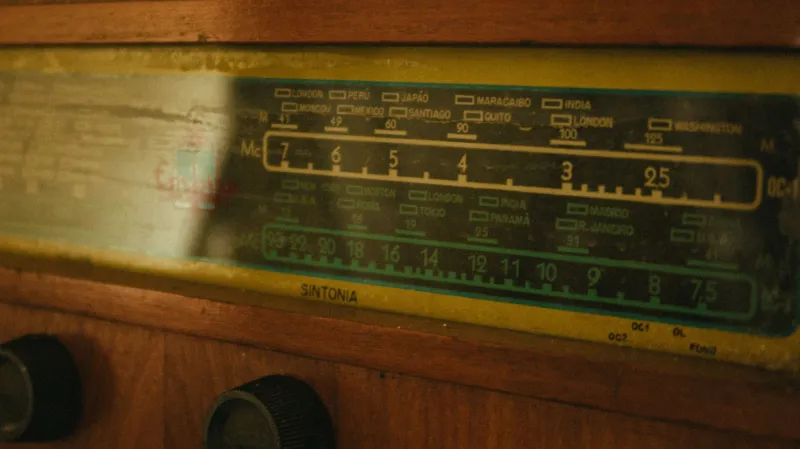
There's a particular kind of loneliness that comes with being awake at 3 a.m., spinning a dial through frequencies nobody else seems to care about. You catch fragments — a woman reading numbers in Spanish, a burst of Morse code, something that sounds like a lullaby played backward through a broken cassette deck. And then, just as suddenly as it appeared, it's gone. Swallowed back into the static.
For a specific breed of American hobbyist in the 1980s and early 90s, that loneliness was the whole point. And somehow, through those crackling frequencies, they found each other anyway.
Before Your Feed, There Was the Dial
Most people think of shortwave radio as something grandparents used to catch BBC World Service broadcasts or Cold War propaganda. And sure, that was part of it. But underneath the official programming — nestled between Voice of America and Radio Moscow — there was something weirder going on.
Amateur radio operators (hams, in the parlance) had long used licensed frequencies to chat, experiment, and generally mess around with signal propagation. But the truly interesting stuff was happening just outside the legal lines. Pirate radio operators were broadcasting experimental music, spoken word art projects, and coded transmissions from makeshift studios — converted garages, basement rigs, the occasional van parked on a rural hillside.
These weren't your classic rock pirates trying to compete with FM stations. These were people transmitting noise compositions at 2 a.m. on a Tuesday. People reading poetry over shortwave static. People sending what appeared to be encrypted messages that, when decoded, turned out to be grocery lists or bad jokes. The joke was the point.
Numbers Stations and the Art of Ambiguity
No conversation about shortwave's underground culture is complete without the numbers stations. If you've never heard one, find a recording online — it's genuinely unsettling. A flat, mechanical voice (sometimes a child's voice, which is somehow worse) reading strings of numbers in a loop. No explanation. No sign-off. Just numbers, then silence.
Officially, most governments have never acknowledged these stations. The prevailing theory is that they were used to transmit instructions to intelligence operatives in the field — a spy's shopping list, broadcast openly because the cipher makes it meaningless without the key.
But the shortwave hobbyist community latched onto them for different reasons. Enthusiast groups like ENIGMA (European Numbers Information Gathering and Monitoring Association) spent years cataloging and attempting to decode these signals. American listeners formed their own loose networks, trading cassette recordings through the mail, comparing notes in newsletters printed on actual paper and sent through actual post offices.
This was peer-to-peer file sharing. It was just analog, and it took three to five business days.
The Characters Who Kept the Signal Alive
Every subculture has its saints and eccentrics, and the shortwave underground had plenty.
There was the operator known only as "Yogi" who broadcast out of somewhere in the Midwest every Saturday night, playing homemade electronic music and occasionally interrupting to read passages from obscure philosophy texts. Listeners never knew his real name. They just knew the frequency and the time, passed along through zines and bulletin board systems that were themselves barely more than organized chaos.
Then there were the art collectives — groups like the Radio Broadcasts Project that treated shortwave as a medium for sound installation. They'd coordinate with listeners across multiple states to tune in simultaneously, creating a distributed audience for a piece of audio art that existed only in that moment, received differently depending on atmospheric conditions and the quality of your receiver. No two people heard exactly the same broadcast.
Sound familiar? It should. That's basically what a live-streamed performance is, except with worse latency and infinitely more charm.
The Technical Mysticism of Long-Distance Signals
Part of what made shortwave culture so strange and compelling was the physics of it. Shortwave signals bounce off the ionosphere, which means a broadcast from a basement in Ohio might be perfectly audible in Argentina while being completely unhearable in the next county. Reception depended on solar activity, time of day, season, and a dozen other variables that introduced genuine unpredictability into every transmission.
This wasn't a bug to the community — it was a feature. The act of receiving a signal became meaningful in itself. You had to work for it. You had to be in the right place, at the right time, with the right equipment and enough patience to sit through hours of interference for thirty seconds of something strange and beautiful.
That friction created investment. When you finally caught a clear transmission of some pirate broadcaster playing homemade synthesizer music from God-knows-where, it meant something. The scarcity made it matter.
What Got Lost When the Internet Won
By the mid-90s, the internet was eating everything. The same nerds who'd been trading cassette recordings of numbers stations were now posting WAV files on early websites. The bulletin board systems that had connected shortwave enthusiasts migrated to Usenet and eventually to forums and social media.
The community didn't disappear — it transformed. Some operators kept broadcasting, and some still do. The Conet Project, a landmark archival collection of numbers station recordings, found a whole new audience when it was released on CD in 1997 and again when it went digital. Shortwave listening clubs still exist, though they're smaller now.
But something was genuinely lost in the translation. The internet is searchable, permanent, and globally consistent. Shortwave was none of those things, and that made it something the internet has never quite been able to replicate: genuinely mysterious. You couldn't Google what you heard at 3 a.m. on 9.925 MHz. You could only listen again tomorrow night and hope it came back.
The Hollow Frequency
Here at Glitch Hollow, we spend a lot of time thinking about signals that don't quite resolve — transmissions from the edges of entertainment and culture that never found a mass audience but mattered deeply to the people who caught them. Shortwave radio's underground scene is maybe the purest version of that idea.
These were communities built on static. On interference. On the beautiful accident of atmospheric bounce delivering something weird and human to your antenna in the middle of the night. They built networks before networks were a concept, and they did it with soldering irons and patience and a genuine belief that someone out there was listening.
Somewhere, right now, someone is still spinning the dial.