Break It On Purpose: How Glitch Stopped Being a Bug and Became a Whole Aesthetic
Let me tell you about the moment I genuinely couldn't tell if my laptop was dying or if I was looking at art.
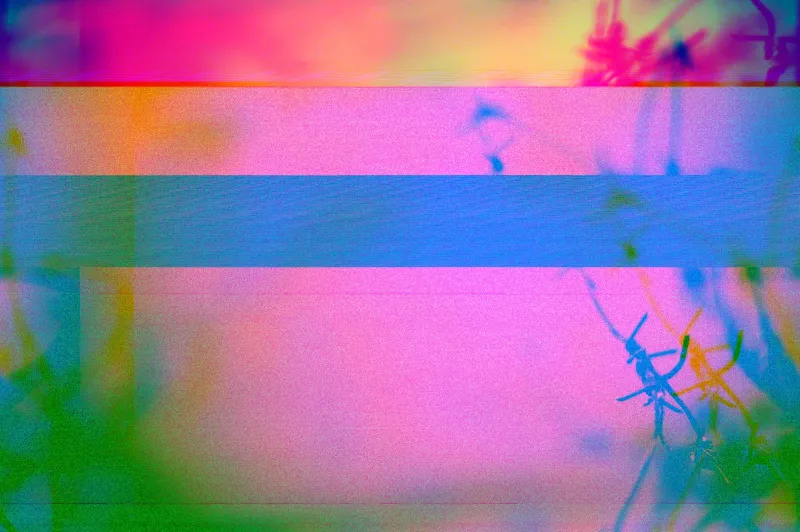
It was a video piece — a figure moving through what might have been a cityscape, except the image kept fracturing. Blocks of pixels would drift sideways, colors would invert for a frame, the whole thing would smear horizontally like someone had dragged a wet hand across the screen. The audio was similarly unstable: clean tones interrupted by digital stutters, silences that felt calculated rather than accidental.
It was gorgeous. And it was doing that thing on purpose.
Welcome to glitch art — a movement built entirely on the premise that breaking your tools is a legitimate creative strategy, and that the errors your software tries to hide from you are actually the most interesting things it has to say.
The Accident That Started Everything
The lineage of glitch aesthetics is long and slightly contentious, depending on who you ask. The easy answer is to point to the early digital video artists of the 1970s and 80s — people like Nam June Paik, who was physically manipulating video signals with magnets and circuit interventions long before anyone was using the word "glitch" as a noun.
But the modern glitch art movement as most people recognize it traces more directly to the 1990s, when consumer electronics became cheap enough that ordinary people could accidentally destroy their own media. A scratched CD that skipped in weird rhythmic patterns. A VHS tape left too close to a speaker that developed strange visual artifacts. A JPEG compressed past its breaking point into a smear of colored blocks.
People noticed that these failures had a visual and sonic language of their own. And a small, obsessive community started asking: what if you did that on purpose?
The Databending Pioneers
The technique that really launched glitch art as a deliberate practice is called databending — opening a file in software that doesn't understand what kind of file it is, and editing it anyway. Open a JPEG in a text editor, add some random characters to the middle of the code, save it, and reopen it as an image. What you get back is unpredictable and often spectacular: the original image fragmenting into cascading color fields, geometric distortions, sections that look like digital geology.
Artists like Ant Scott (who ran the influential Beflix site) and Rosa Menkman (whose "Glitch Studies Manifesto" became something of a foundational document for the movement) were among the people codifying these techniques in the early 2000s. Menkman's manifesto, published in 2009-2010, argued that glitch wasn't just a visual style but a philosophical stance — a way of interrogating the smooth, seamless surface that technology presents to us and asking what's being hidden underneath.
That's a pretty heavy argument for what is, at its most basic level, deliberately corrupting your own files. But it holds up.
Glitch Music: When Audio Breaks Beautiful
The visual side of glitch gets most of the press, but the musical dimension is equally fascinating and arguably got there first.
In the mid-90s, a cluster of electronic musicians — loosely associated with labels like Mille Plateaux and the broader "clicks and cuts" scene — were building compositions out of the sounds that digital audio systems make when they fail. Skips, buffer underruns, aliasing artifacts, the particular texture of audio compressed into oblivion. Artists like Oval (Markus Popp) were literally scratching CDs and recording the results, then building those textures into full compositions.
What emerged sounded like nothing else. Not ambient, not industrial, not noise (though it had relationships with all three) — it was something genuinely new, and it came directly from treating malfunction as material.
More recently, this lineage runs through artists like Arca, whose productions deliberately destabilize rhythm and timbre in ways that feel like glitch aesthetics applied to pop music infrastructure. You can hear it in certain corners of hyperpop, in experimental hip-hop production, in the kind of electronic music that makes you feel like your headphones are both working perfectly and slightly broken at the same time.
The Mainstream Swallow
Here's where it gets complicated: glitch went mainstream. Or at least, glitch aesthetics did.
By the 2010s, the visual language of glitch — the horizontal smearing, the RGB channel separation, the pixelated decay — was showing up in music videos, advertising campaigns, and movie title sequences. It became a shorthand for "digital," "edgy," and "tech-adjacent," deployed by brands that had no particular interest in the philosophical underpinnings of the movement.
This is the usual trajectory for any subculture aesthetic, and the glitch community's response was predictably mixed. Some practitioners argued that commercialization was fine — the techniques spread further, more people engaged with the ideas. Others felt that reducing glitch to a visual filter missed the entire point, which was about process and interrogation, not just appearance.
The debate is still live. When a major streaming platform uses glitch-style visuals in its interface design, is that a validation of the movement or a hollowing-out of it? Probably both, which is the honest answer to most questions about aesthetics and commerce.
Why Error Tells the Truth
Here's the argument that actually convinces me glitch art is doing something important beyond just looking cool.
Every piece of technology we interact with is designed to present a seamless, frictionless surface. Your phone doesn't want you thinking about the processors and antennas and software layers that make it work. Your streaming service doesn't want you noticing the compression artifacts in the video. The whole design philosophy of consumer technology is: make the machine invisible, make the experience feel natural and inevitable.
Glitch art breaks that contract. When an image corrupts, you suddenly see the underlying structure — the grid of pixels, the way color information is encoded, the seams in the compression algorithm. The error reveals the architecture. And that revelation is genuinely interesting, because it reminds you that all of this is constructed. None of it is natural. Someone made choices, and those choices have consequences, and sometimes those consequences are beautiful.
That's not a trivial thing to communicate. And it's something that polished, seamless digital art — however technically impressive — can't really say.
The Hollow in the Signal
Glitch Hollow exists somewhere in this territory — at the edges of entertainment culture, where the signal breaks down and something honest comes through. The glitch art movement, at its best, is doing the same thing: finding the meaning in the malfunction, the signal in the static.
Next time your video freezes on a weird frame, take a screenshot. You might be looking at something.